You Won’t Believe These Hidden Cultural Gems in Atlanta
Atlanta is more than just peach trees and busy streets—deep beneath its modern surface lies a world of secret cultural venues most travelers never see. I stumbled upon these spots by chance, and honestly, they changed how I see the city. From underground art collectives to tucked-away music halls, Atlanta’s true soul lives in these quiet, powerful spaces. If you're looking for authenticity over crowds, this is where the real story begins. These are not the kinds of places advertised on double-decker tour buses or ranked by algorithms. They thrive in basements, repurposed warehouses, and neighborhood corners where creativity flows without permission. This is a journey into the heartbeat of a city often misunderstood, where culture isn’t performed for tourists—it’s lived, shared, and protected by those who call Atlanta home.
The Unexpected Heart of Atlanta’s Culture
When most people think of Atlanta, they picture skyscrapers, Hartsfield-Jackson International Airport, or the bustling energy of Midtown. It's a city known for its pace, its growth, and its role as a hub of the New South. Yet beneath the surface of this modern metropolis lies a cultural undercurrent that resists commercialization and demands presence. These hidden spaces—often unmarked, unadvertised, and discovered only through local whispers—are not just alternatives to mainstream attractions. They are essential. They represent the living memory of Atlanta, shaped by generations of artists, storytellers, musicians, and community builders who have quietly sustained the city’s soul.
What makes these venues so vital is not just their artistic output, but their role as sanctuaries. In a city undergoing rapid gentrification and transformation, these spaces offer continuity. They are where young poets test their first verses, where elders pass down oral histories, and where forgotten sounds are resurrected on vinyl. Unlike curated museum exhibits, these places operate in real time. They are not preserved behind glass—they are alive, evolving, and deeply participatory. To visit them is not to observe, but to engage. And that engagement fosters a deeper understanding of Atlanta not as a destination, but as a community.
These hidden gems also challenge the notion that culture must be large, loud, or monetized to matter. A basement gallery in Inman Park may host only thirty people at a time, but the impact of seeing a young Black artist’s first solo show can ripple through a neighborhood. A monthly storytelling night in a coffee shop may seem small, but it keeps the voice of old Atlanta alive for younger generations. These are not just cultural events—they are acts of preservation, resistance, and love. In choosing to visit them, travelers move beyond consumption and into connection.
The Basement Arts Scene in Inman Park
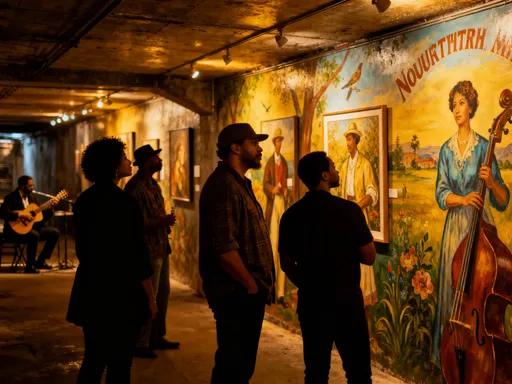
Nestled beneath a century-old Victorian home in Inman Park, there’s a space most Atlantans don’t know exists. No sign marks the entrance. No website lists its hours. You find it by invitation, by word-of-mouth, or by the luck of walking past just as the heavy wooden door swings open and the low hum of jazz spills onto the sidewalk. This is the Inman Park Underground, a grassroots gallery run entirely by local artists, many of whom are emerging voices from Atlanta’s Black and Southern creative communities. Descend the narrow staircase, and you step into a world where every surface tells a story—walls painted with murals that shift with each exhibition, floors worn smooth by decades of footsteps, and ceilings that seem to lean in, as if listening.
The atmosphere is intimate, almost reverent. Lighting is dim, not for drama, but to draw focus to the art—bold acrylic paintings, mixed-media collages made from old family photographs, sculptures crafted from reclaimed wood and railroad spikes. The music, always live or carefully curated, is never louder than a conversation. On any given night, you might hear a jazz trio playing original compositions inspired by the Great Migration, or a poet reciting verses about growing up in Southwest Atlanta. There’s no admission fee, but a donation jar sits near the exit, labeled simply: “Keep the Light On.”
What makes this space extraordinary is its deliberate obscurity. The artists who run it choose not to promote it widely. They don’t post on social media. They don’t seek press. Their goal isn’t visibility—it’s authenticity. They want only those who are truly interested to find their way here. This exclusivity isn’t about elitism; it’s about protection. In a city where rising property values push out long-time residents, spaces like this are fragile. By staying under the radar, they remain free from commercial pressures and gentrification’s reach. To be invited is a quiet honor, a sign that someone trusts you to respect the space.
Exhibitions rotate every six weeks, each one centered on a theme—“Roots and Routes,” “Sacred Geometry,” “Voices from the Porch.” Many of the artists are self-taught, their work rooted in family traditions, spiritual practices, and Southern aesthetics. The gallery has become a launching pad for careers, with several artists going on to show in larger institutions. Yet they often return to exhibit here first, as a kind of homecoming. To visit the Inman Park Underground is to witness culture in its most organic form—unmediated, unfiltered, and deeply human.
A Night at the Historic West End Theater
Just off Lee Street in Atlanta’s West End neighborhood stands a building that looks like it time-traveled from another century. The West End Theater, built in 1923, was once a vaudeville hall where Black performers entertained segregated audiences during Jim Crow. Closed for decades and nearly lost to demolition, it was restored in 2016 by a coalition of local historians, artists, and preservationists. Today, it stands as one of the city’s most powerful cultural landmarks—not because it’s polished or grand, but because it remembers. Walking through its arched entrance, you feel the weight of history: the creak of the wooden floors, the glow of the restored chandelier, the hand-painted murals along the balcony walls depicting scenes from African American theater and music.
The theater now hosts a rotating calendar of events—indie film screenings, live poetry performances, jazz ensembles, and community forums. On a recent Friday night, it was filled with an audience of all ages for a screening of a documentary about Atlanta’s hip-hop pioneers, followed by a panel with local musicians. The energy was electric, not in a flashy way, but in the quiet hum of recognition—people seeing their city’s story told truthfully, on a screen in a place that once refused them entry. The theater’s programming is carefully curated to honor its past while nurturing new voices. It’s not a museum piece frozen in time; it’s a living stage where history and innovation meet.
One of its most beloved traditions is the “Legacy Nights” series, held every other month. These events feature elder performers—singers, dancers, storytellers—who share work they’ve carried for decades, sometimes pieces never before performed publicly. In one unforgettable evening, a 78-year-old tap dancer took the stage, her rhythm sharp and precise, her movements a conversation with the floorboards. Afterward, she spoke about performing here as a teenager, when the theater was one of the few places Black artists could be seen and heard. “They thought they could silence us,” she said, “but the walls remember.”
The West End Theater also runs an apprenticeship program for youth, teaching stage management, sound engineering, and performance skills. Many of the ushers and technicians are teenagers from nearby schools, learning not just technical skills, but the importance of cultural stewardship. The theater doesn’t just host events—it builds community. It’s a place where art is not separate from life, but woven into it. To attend a show here is to participate in something larger than entertainment. It’s to witness resilience, to honor memory, and to support the next generation of storytellers.
The Secret Behind the Atlanta Music Vault
On an unassuming stretch of the Westside Trail, near a bend in the Atlanta BeltLine, there’s a windowless warehouse with no signage. If you didn’t know it was there, you’d walk right past. But inside, one of the city’s best-kept musical secrets comes alive every weekend. The Atlanta Music Vault is not a museum, not a record store, and not quite a club. It’s all of these things, blended into a singular experience. Run by a collective of archivists, sound engineers, and Southern music enthusiasts, the Vault is dedicated to preserving and sharing the region’s rich musical heritage through analog listening sessions, live recordings, and educational events.
The heart of the space is its collection—a meticulously cataloged archive of over 15,000 vinyl records, reel-to-reel tapes, and 78s. The focus is on Southern genres: gospel, blues, soul, early R&B, and regional folk. You’ll find rare gospel recordings from rural Georgia churches, unreleased demos from 1960s Atlanta soul bands, and field recordings of front-porch musicians from the Piedmont region. Nothing is digitized. Everything is meant to be heard the way it was made—on turntables, through vintage tube amplifiers, in a room designed for acoustic warmth. The sound is not just heard; it’s felt, vibrating through the wooden floor and into your chest.
One of the most popular events is the “Blind Listen” night, held monthly. Attendees gather in a semi-circle around a large turntable, blindfolded or with eyes closed. A record is played—no title, no artist announced. The group listens in silence, then shares impressions: the mood, the instrumentation, the era they think it’s from. Only after the discussion is the record revealed. These sessions do more than teach music history—they rebuild listening as a communal act. In an age of streaming playlists and isolated headphones, the Vault restores the ritual of shared attention.
The space also functions as a working analog studio. Local artists book time to record live, using vintage microphones and tape machines. The engineers insist on minimal editing—what you hear is what happened in the room. Several breakout Southern artists have recorded debut albums here, drawn by the authenticity of the sound. The Vault doesn’t seek fame for itself. It doesn’t have a public website or social media presence. Information spreads through flyers at coffee shops, word-of-mouth, and occasional listings on community bulletin boards. To find it, you must want to. And once you do, you’re likely to return—not just for the music, but for the sense of belonging it creates.
Cultural Coffee: How Cafés Are Preserving Storytelling
In Atlanta, coffee is more than a morning ritual—it’s a vessel for culture. Across neighborhoods like East Lake, Edgewood, and Westview, small, independently owned cafés have become unlikely guardians of oral tradition. These are not chain shops with uniform menus and piped-in music. They are deeply local spaces, often family-run, where the walls display handmade quilts, the shelves hold books by Southern authors, and the tables are set for conversation. Many host weekly events that transform the café into a living archive: poetry readings, craft workshops, and most importantly, storytelling nights.
One of the most cherished is “Story Sundays” at The Hearth & Bean in East Lake. Every third Sunday, the café closes early and reopens at 5 PM for an intimate gathering. A single microphone stands at the center, and elders from the neighborhood are invited to share memories of old Atlanta—what it was like to grow up here in the 1950s, how the neighborhood changed after the civil rights movement, what it meant to raise a family in a city in flux. The stories are not rehearsed. They are raw, heartfelt, and often laced with humor. A woman once described learning to roller skate on asphalt in her church parking lot; a man recalled the first time he saw a television at a neighbor’s house in 1958. These moments are recorded and archived, with permission, in a digital library accessible to local schools.
The café’s owner, a third-generation Atlantan, started the series to bridge generational gaps. “I noticed that young people knew the new Atlanta,” she said, “but not the one that built it.” Story Sundays have become more than nostalgia—they’re a form of cultural transmission. Students attend for research, families come to hear grandparents speak, and newcomers listen to understand the city’s roots. The event ends with a communal meal, often featuring dishes from the storytellers’ childhoods—biscuits, collard greens, peach cobbler—prepared by local volunteers.
Other cafés have followed suit. In Westview, a coffee shop hosts “Poetry & Pie,” where local writers read original work while guests enjoy homemade desserts. In Edgewood, another runs “Craft & Conversation,” teaching traditional quilting and storytelling together. These spaces prove that culture doesn’t need grand institutions to survive. Sometimes, it thrives in the quiet corner of a café, over a second cup of coffee, in the voice of someone who remembers.
Getting There: Navigating Atlanta Like a Local
Exploring Atlanta’s hidden cultural spots requires a different kind of travel—one that values slowness, curiosity, and local insight. While rental cars and ride-shares are convenient, they often keep visitors on the surface, moving between well-marked points. To truly connect with these spaces, it’s better to move like a resident. The Metropolitan Atlanta Rapid Transit Authority (MARTA) is a reliable and affordable way to reach many neighborhoods. The red and gold lines connect downtown to the Arts Center, Midtown, and beyond, while the south line runs close to the West End Theater and several community arts hubs.
For a more immersive experience, consider biking the Atlanta BeltLine. This 22-mile loop, built on a former railway corridor, links dozens of neighborhoods and passes near several underground cultural venues. Rental stations are available at multiple access points, and the trail is well-marked and safe during daylight hours. Biking allows you to notice details—murals, small galleries, pop-up markets—that you’d miss from a car. Many locals use the BeltLine not just for exercise, but as a cultural route, stopping at cafés, listening to street musicians, and attending open-air events.
Walking is another powerful way to explore. Atlanta’s older neighborhoods—Inman Park, Grant Park, Virginia-Highland—have tree-lined streets, historic homes, and a pedestrian-friendly rhythm. Strolling through these areas during daylight hours offers safety and access, especially for venues that are tucked into residential spaces. It’s not unusual to stumble upon a small art show in a front yard or hear music drifting from an open basement door.
To stay informed about events, rely on local resources. The Atlanta Journal-Constitution’s arts section, neighborhood Facebook groups, and community bulletin boards at libraries and coffee shops often list pop-up exhibitions, live performances, and storytelling nights. Apps like Eventbrite and Meetup can also help, though the most meaningful events are sometimes shared only through personal networks. The key is to ask—baristas, bookstore owners, and transit workers often know more than any guidebook. And if someone gives you a tip, honor it by showing up with respect and an open heart.
Why These Spaces Deserve Your Attention
In a city that’s constantly reinventing itself, these hidden cultural spaces are not just charming anomalies—they are acts of resistance. They remind us that culture is not something you consume; it’s something you participate in. They thrive not because they attract thousands, but because they mean something to the few who find them. To visit these places is to reject the idea that travel is about ticking off landmarks. It’s about slowing down, listening deeply, and recognizing that the soul of a city lives in its quiet corners.
Supporting these venues is also an ethical choice. In Atlanta, as in many growing cities, rising costs and development pressures threaten the survival of grassroots spaces. When travelers choose to attend a poetry reading in a café, buy art from a local gallery, or donate to a restored theater, they help sustain culture that might otherwise disappear. These acts of attention are small but powerful. They signal that there is value in the unseen, the unpolished, the authentic.
Moreover, these spaces foster connection across generations and backgrounds. A young visitor might hear a story that reshapes their understanding of the city. A longtime resident might feel seen, their memories honored. A musician might find inspiration in a 70-year-old gospel recording. These moments of exchange are the true purpose of travel—not to collect experiences, but to build empathy.
Atlanta’s hidden cultural gems do not ask for fame. They do not need crowds. They only ask to be witnessed, respected, and kept alive. By seeking them out, travelers become part of something greater—a network of care, memory, and creativity that defines the city’s true identity. In a world of sameness, these places are rare. They are fragile. And they are worth protecting.
The journey through Atlanta’s hidden cultural landscape is not about finding the next big attraction. It’s about discovering meaning in the margins, beauty in the overlooked, and humanity in the everyday. These spaces remind us that culture is not a product, but a practice—one that requires presence, patience, and purpose. So the next time you visit Atlanta, look beyond the skyline. Step off the main streets. Listen for the jazz drifting from a basement, the stories rising in a café, the echoes of a theater that remembers. Because in those quiet moments, you’ll find the city’s true heartbeat. And you’ll leave not just with memories, but with a deeper understanding of what it means to belong.